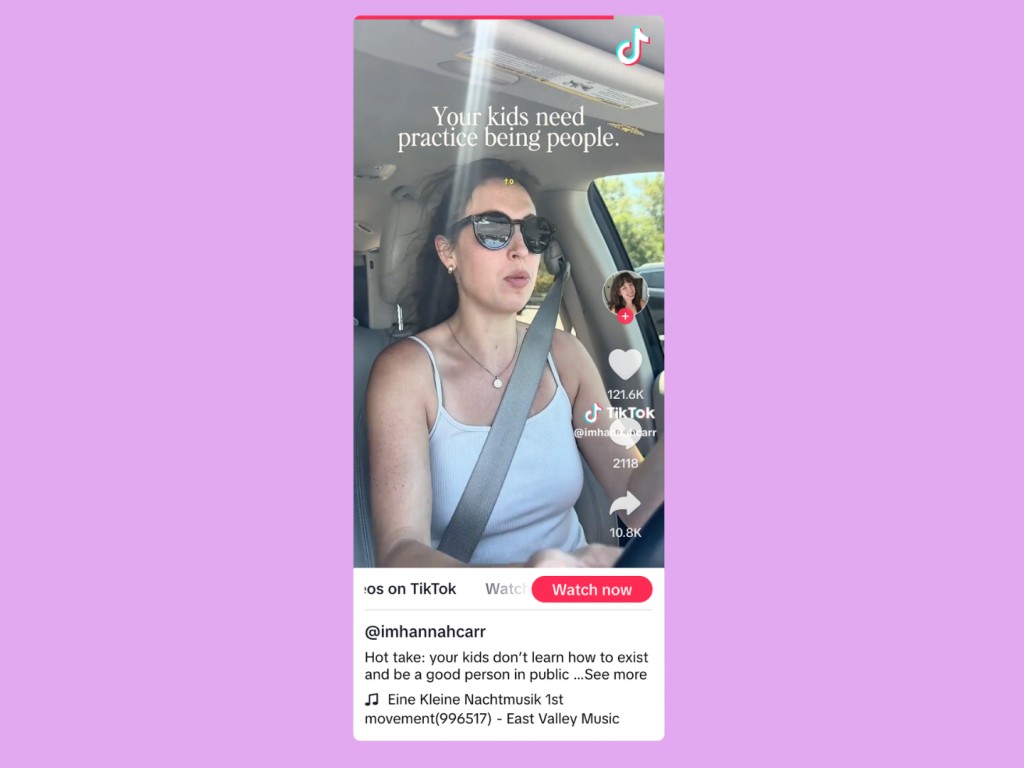
Hannah Carr is tired of the side-eyes.
She has four kids. Ages six, four, three, and one. Take a deep breath. That is a lot of young humans to manage in a crowded grocery store or a noisy movie theater. She posts on TikTok as @imhannahcarr. Her feed mixes weeknight dinner ideas with blunt parenting advice.
One video, viewed over 600,00 times, cuts through the noise.
Her core argument? You have to take your kids out. Publicly. Loudly. Messily.
The goal is simple but often ignored. Children need to learn how to be good people in public. Not in a vacuum. Not in a playroom with only their siblings. Out there. Among strangers. In the real world.
“People look at me crazy,” Carr admits. She hears it constantly. You really have your hands full. She doesn’t care. The judgment of others matters less than the development of her children.
Why is this specific socialization so important?
Carr frames it with a hot take: “You need to take your small children out so they can learn how to human.”
It sounds rough. It is rough. Tantrums happen. Tears flow. Noise erupts. But avoidance creates ignorance. If a child never sees a busy restaurant, how do they learn to sit still? If they never go to a park, how do they navigate sharing a swing?
The answer to the “how to be a good person in public” question lies in exposure.
Carr lists the necessary venues clearly:
- Grocery stores
- Movie theaters
- Public parks
- Outdoor walks
- Restaurants
These aren’t just errands. They are classrooms.
It’s your job to show them… how to be a positive person… It’s your job, and if it stressed you out, that’s too bad.
Yes, it is stressful. Carr owns that.
“Well, it stresses me out. Too bad.”
She doesn’t sugarcoat the parental experience. She is stressed. Her kids are stressed. But stress is part of the growth equation. Both she and the children are learning. Both are growing.
Parents in the comments agreed. One user added a critical tactical detail: take them out without phones and tablets. Another noted that kids won’t know how to act if kept indoors.
The alternative to public exposure is a lack of social calibration.
We protect children from judgment so thoroughly that we sometimes shield them from the very lessons judgment helps teach. Social norms are learned through friction. Through awkward pauses. Through the need to quiet a crying sibling in a silent theater. Through the patience required to wait in a long checkout line.
Carr’s point lands hard. It’s not about perfection. It’s about presence.
Your child cannot learn societal norms in isolation. You must put them in the fire of everyday society. Let them stumble. Let them cry. Let strangers stare.
It is your job. And it is hard.
That’s the point.