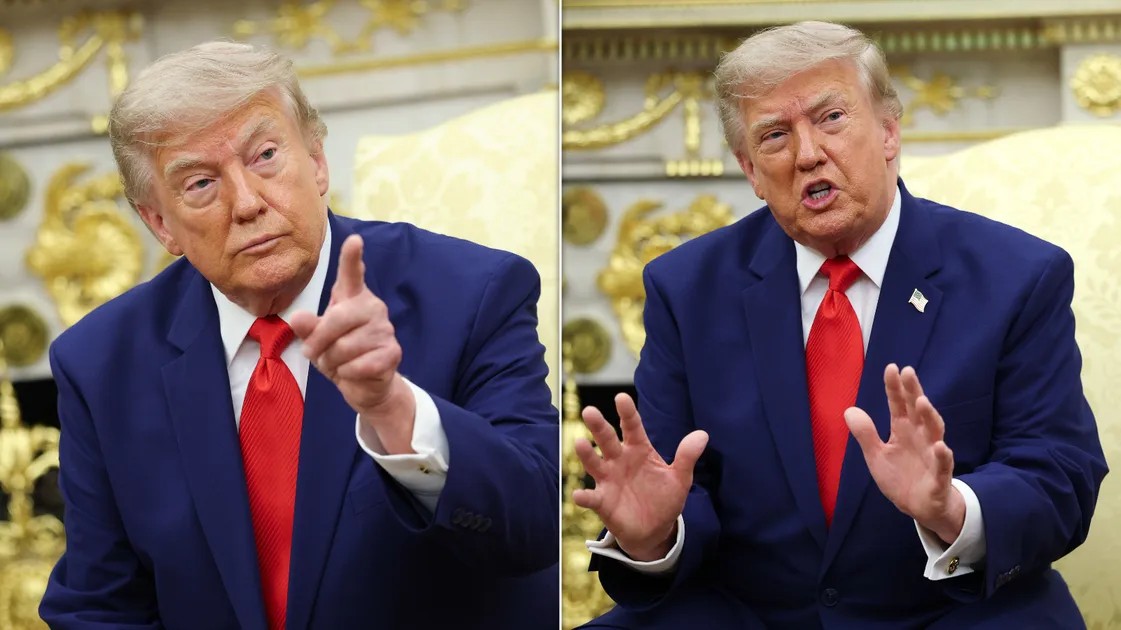
It wasn’t a question. Not really.
Donald Trump didn’t actually want to know what Mary Bruce knew about the Iran War. When the ABC News chief White House correspondent asked if he had a plan to de-escalate the conflict, Trump looked visibly annoyed. The Oval Office press briefing, usually a place where the president answers to the public’s press pool, turned into a power play.
“They’re getting decimated,” Trump said. Then came the other lines: “You don’t know anything.” And finally, repeated with heavy emphasis: “Do you know something I don’t don’t know?”
The exchange was tense. Abrupt. And according to behavioral experts, entirely calculated.
The Illusion of a Question
Language experts say this specific phrase is a trap. It sounds like an inquiry but functions as an insult.
“This is framed as a question, but the underlying statement is: ‘You know nothing, and I know everything,’” Sandra Maurer, a clinical counselor from Minnesota, told HuffPost.
Denise Dudley, a clinical psychologist, agreed. To her, the phrase is a rhetorical device designed to put the asker in their place. It isn’t meant to be answered. There is no correct response to “Do you know something I don’t know?” other than submission.
“It reverses the typical power dynamic,” Dudley explained. Normally, the person asking the question holds the upper hand. They control the narrative. They demand truth. Trump flips that script instantly. He becomes the only credible source. He paints the reporter as ignorant. It’s an evasion tactic wrapped in grammar.
Karen Stollznow, a linguistics author, sees it as a direct challenge to authority. It’s not a request for information. It’s a move to undermine the premise of the journalism itself. By suggesting Bruce lacks the knowledge to ask the question, Trump puts her on the defensive.
Who gets to claim knowledge? Who is allowed to speak? In that room, it was clearly only Trump.
A Pattern of Dismissal
Maurer pointed out that this isn’t new. This is how Trump speaks to anyone he perceives as inferior. Everyone, really. Except maybe those who kneel before his power.
He sees the world in terms of dominance. Reminding her of a 2016 debate with Hillary Clinton, where he loomed and hovered, Maurer noted the consistency. Whether it was a stage or a White House briefing, the goal is the same: secure the power dynamic. Make sure he is the domineering force.
He also took aim at the media outlet. Calling it a “fake station,” he shifted the conversation away from Iran policy and toward the credibility of the press. Attack the messenger. Dismiss the message.
The Patriarchy and the “Shit List”
Why the aggression? Why specifically toward a woman challenging him?
Experts say this interaction highlights the patriarchal foundation of Trump’s brand. He built his image on a specific type of masculine control. When a female-presenting person challenges him, it triggers a deeper insecurity.
“Women who support his power escape punishment,” Maurer said. “But the second they step outside that… they’re on the shit list.”
Take Marjorie Taylor Greene. Once a MAGA darling. Now, thanks to her leaving the Republican party, she’s “Marjorie Traitor Brown.” The rule is simple: agree with me, or be destroyed.
Will Lacey-Bisetty, a neuropsychologist in California, sees this as a microcosm of Trump’s entire approach. When he feels confronted, he goes defensive. It’s aggressive. It’s protective of a fragile ego built on total control.
Anytime he is not the center of authority, he is insecure. He must reassert it.
Repetition as a Weapon
Note the repetition.
Trump didn’t just ask it once. He asked it multiple times. Stollznow says this is significant.
Repeating the phrase reinforces the dismissal. It allows him to avoid answering the actual question about Iran. It infantilizes the journalist. It diminishes her competence. It invites the audience to question her skill rather than the substance of her query.
It’s a communication strategy that signals something broader, too.
Lacey-Bisetty argues this sends a message to other men and boys. This is how you present in these settings. This is how you communicate with authority. Dominate. Interrupt. Dismiss.
It’s scary on an individual level. But the messaging? The implication that leaders are above accountability? That’s the real story here.
Trump left Bruce without an answer. He left the Iran crisis unaddressed. But he made his point. He was still the one in charge.